Make a Twitter feed like this one for your film (link opens so that you can scroll down). Keep it up to date. Take screenshots at different times. Post the screenshots on your Evaluation question 5 Attracting and addressing audiences. Even if another member of your group is making a Twitter page for your group film, there is nothing to stop you going for the extra marks by doing it yourself!
Last year you set up a Twitter page and you will continue to use it this year. What for?
- To
communicate instantly and effectively with the rest of your group and
your class. You will share your thinking as well as attach information /
hyperlinks / pictures that relate to your work.
- To receive new information quickly.
It's an amazing human search engine that harnesses the crowd. You'll
follow all sorts of movers and shakers. use the hashtag to follow
specific threads.
- To start a conversation with strangers as well as friends. Fresh ideas when you're thinking about something.
- To create a community of people interested in what you are interested in: invite responses; follow up ideas.
- To
learn from some great minds and experienced teachers in various Media
fields. If something interets them, it may well be of interest to us.
'Follow' wisely.
- To
invite feedback: your third Evaluation question. You may get a
completely fresh, honest opinion. That's worth having. Potentially, you
have access to millions of people.
- To track the band that you have chosen for your promo pack.
See why the journalist Alan Rusbridger values Twitter in The Guardian newspaper here.
Movies and Social Media: Marketing films with new media Why filmmakers use social media: article by Caitlin Neely 03.06.15
Pete Fraser writes:
So who is worth following for A level Media?
@julianmcdougall wrote the OCR textbook and he tends to use his tweets to send out useful links for the A2 exam in particular
 @henryjenkins is the American academic who wrote 'Convergence Culture' and has done a lot of research on fans
 @ainnucci
Armando Iannucci the creator of 'The Thick of It' and Alan Partridge,
amongst much more, is always amusing and interesting
@ainnucci
Armando Iannucci the creator of 'The Thick of It' and Alan Partridge,
amongst much more, is always amusing and interesting
 @petesmediablog is me- I don't say much but you might find other people I follow quite interesting!
 Get
yourself on there, add a few people then have a hunt around for
comedians, actors, film-makers, politicians, journalists you find
interesting. It could open you up to a whole load of interesting stuff!
Get
yourself on there, add a few people then have a hunt around for
comedians, actors, film-makers, politicians, journalists you find
interesting. It could open you up to a whole load of interesting stuff!
From The Guardian
We look at cinema in the year 2015 and note in particular:
- blockbusters / franchises / superhero films
- independent cinema / arthouse cinema
- Kodak 'saved' so past and present technologies co-exist (35 mm film stock)
- trends such as the advent of laser projection has helped to overcome some of the light-loss issues traditionally associated with stereoscopy.
- women filmmakers
- trends such as animation: more than any other area of movie-making, animation demonstrates
perfectly how the old and the new, past and future, can coexist. Aardman’s Shaun the Sheep finding a firm foothold in the multiplexes, Tomm Moore’s Song of the Sea
taking inspiration from the hand-crafted 2D artistry of Ghibli , and Laika studios continuing to blur the line between
the physical and the digital with scrungy delights like The Boxtrolls, it’s hard to remember a time when ancient skills and newfangled advances were so intertwined. Inside Out: a possible contender for best film 2016?
- trends such as simultaneous release (theatrical and Netflix) Beasts of No Nation
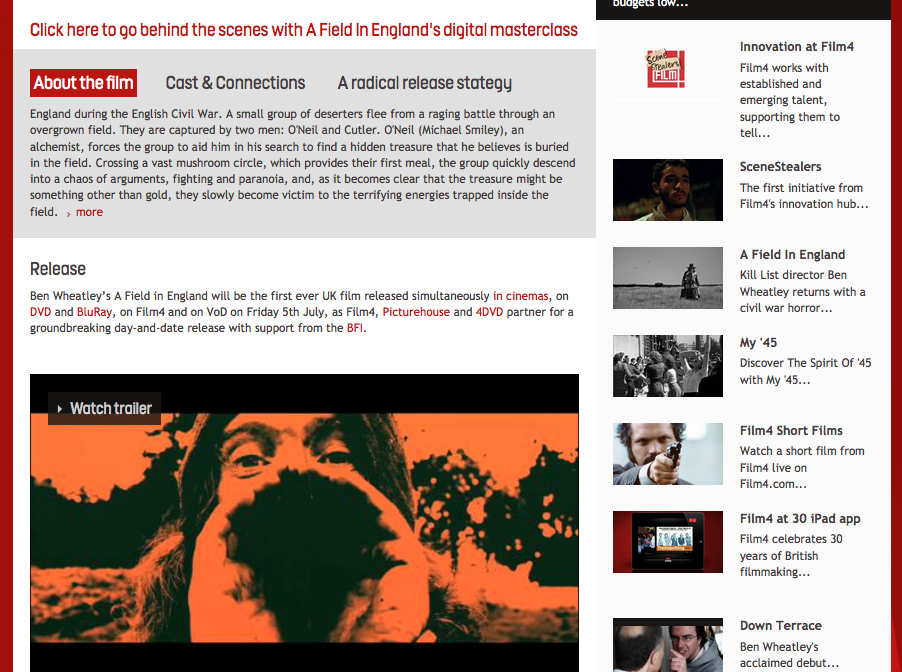
- for example, Ben Wheatley’s ground-breaking A Field in England, released simultaneously across a range of platforms (free-to-air
TV, video-on-demand, DVD, cinemas) “enabling viewers to decide how,
where and when to view the film”.
View the extract here. The focus is on the representations of ethnicity.
You analyse the extract under exam conditions and hand in your written answer for marking. The examiners' report is below:
 In class, I introduce you to the world cinema platform MUBI and we analyse the 4 technical codes of the opening of Bram Stoker's Dracula (dir. Francis Ford Coppola, 1992): camerawork, mise-en-scene, sound and editing. We note the creative use of light (shadows falling across the map of Transylvania; silhouettes of lances and corpses on the battlefield); of wind (ruffling the prince's hair; at the moment of damnation); of sound (non-diegetic vocals in the form of a chorus of female voices chanting foreign words in an elegy); and of liquid (blood pooling around the outstretched hand of Elisabetta). The aim of this activity is to improve analysis of technical codes and to learn creative techniques from master filmmakers.

 We move on to study British Cinema, starting with the website of Working Title, by looking at what films they produce and what is in the pipeline. We learn about their history and why they are successful. Using examples, we note how the subject matter of British films serves national audiences such as by dealing with British concerns, social history, culture and interests. The class identifies which WT films they have seen. Many of you will associate WT films with 'safe' mainstream topics, such as the Bridget Jones franchise, Mr Bean, Love Actually, Four Weddings and so on. However, WT makes a wide variety of films, not just those that create a sanitised version of Britishness that would sell the UK to international audiences of culture tourists. Look at our next choice.
We watch the trailer for The Danish Girl: directed by Academy Award winner Tom Hooper (Les
Misérables) and starring Academy Award winner Eddie Redmayne (The Theory
of Everything) and Alicia Vikander (Anna Karenina), it will be released in
the US by Focus Features beginning on Friday 27 November. What makes this film controversial? How might this film be received by different audiences?
We move on to study British Cinema, starting with the website of Working Title, by looking at what films they produce and what is in the pipeline. We learn about their history and why they are successful. Using examples, we note how the subject matter of British films serves national audiences such as by dealing with British concerns, social history, culture and interests. The class identifies which WT films they have seen. Many of you will associate WT films with 'safe' mainstream topics, such as the Bridget Jones franchise, Mr Bean, Love Actually, Four Weddings and so on. However, WT makes a wide variety of films, not just those that create a sanitised version of Britishness that would sell the UK to international audiences of culture tourists. Look at our next choice.
We watch the trailer for The Danish Girl: directed by Academy Award winner Tom Hooper (Les
Misérables) and starring Academy Award winner Eddie Redmayne (The Theory
of Everything) and Alicia Vikander (Anna Karenina), it will be released in
the US by Focus Features beginning on Friday 27 November. What makes this film controversial? How might this film be received by different audiences?
You can segment audiences loosely as being global, international, national and niche. For films, the terms mainstream and blockbuster can be used in opposition to art house. We move on the British film maker Terence Davies as an example of a superb auteur director with niche audiences. We watch the opening of the cult classic Distant Voices, Still Lives, Terence Davies' moving portrayal of working-class life in 1940s and
50s Liverpool.
We dip into the Guardian interview of Terence Davies then catch up with Sunset Song, Davies's current venture, by watching the trailer for his new release.
Sunset Song stars Agyness Deyn and is an adaptation of Lewis Grassic Gibbon's novel about a farming family torn apart by tragedy on the eve of the first world war. Read the review here. What makes it important for national audiences? What films have you seen about British social history (that aren't costume dramas)?