Friday, 5 October 2012

CREATE YOUR BLOG
- Create your own blog using Blogger
- Add the class blog and your group's blogs to it
- Add the gadget 'search engine'
- First post: your poster MY MEDIA made using Comic Life. Explain how you made it.
- Second post: your film opening 'CHERIE': MAKING A FILM OPENING .Explain how you made it. Refer to seeing Delicatessen (Directed by Marc Caro, Jean-Pierre Jeunet 1991)
- Create your own Twitter account and 'follow' my suggested links.
- Tweet using Twitter ( on a media related topic only, e.g. Skyfall's premiere, your views on the last film that you have seen, the iPhone 5, music/bands/gigs, new technology, TV programmes.....)
- Third post: a screen shot of your first 5 Twitter posts.
- Add Twitter gadget to your blog.
FOLLOW ON TWITTER
First, we learn why the journalist Alan Rusbridger values Twitter in The Guardian newspaper here.
TWITTER
You are setting up a Twitter page and you will continue to use it this year. What for?
First, we learn why the journalist Alan Rusbridger values Twitter in The Guardian newspaper here.
- To communicate instantly and effectively with the rest of your group and your class. You will share your thinking as well as attach information / hyperlinks / pictures that relate to your work.
- To receive new information quickly. It's an amazing human search engine that harnesses the crowd. You'll follow all sorts of movers and shakers. use the hashtag to follow specific threads.
- To start a conversation with strangers as well as friends. Fresh ideas when you're thinking about something.
- To create a community of people interested in what you are interested in: invite responses; follow up ideas.
- To learn from some great minds and experienced teachers in various Media fields. If something interests them, it may well be of interest to us. 'Follow' wisely.
- To invite feedback for your evaluation question. You may get a completely fresh, honest opinion. That's worth having. Potentially, you have access to millions of people.
'Follow' institutions and individuals who will widen your understanding of media issues.
Thursday, 4 October 2012
G322 RESEARCH INTO BRITISH FILM
PREP due Thursday 11 September YOU WILL PRESENT THIS TO CLASS
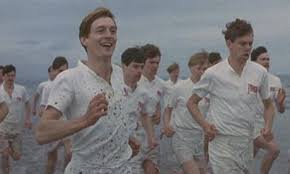
- Pick 3 British films that have been released in the last 18 months or so. Title (directed by.....date e.g. 2011)
- State which websites you consulted to do your research.
- Screenshot your films' websites, FaceBook, Twitter pages.
- For each, write a thoughtful paragraph stating the way in which each film attracts/addresses national, international or global audiences.
- What is the impact of Vangelis's music in the opening scene of training on the beach?
- How are both Eric Liddell and Harold Abrahams constructed as outsiders? (Discuss Abraham's 'welcome' by the college porter; the college masters' scornful observations of the College Dash)
- How is the British Establishment constructed through the use of setting (Cambridge colleges, Kings College Chapel, the freshmen's dinner)
- What is the function of cross cutting from the College Dash to the highland games? What parallels are drawn?

Tuesday, 2 October 2012
TV DRAMA G322:MARK SCHEME
Your analysis of the scenes from Made In Dagenham is due in today.
Assessment will take place across
3 criteria:
- explanation/analysis/ argument (20 marks)
- use of examples (20 marks)
- use of terminology (10 marks)
A top level answer will meet the following standards:
Explanation/analysis/argument
- shows excellent understanding of the task
- excellent knowledge and understanding of the technical aspects used in the extract
- excellent discussion of the extract’s representations, clearly linked to textual analysis
- clearly relevant to set question
Use of examples
- offers frequent textual analysis from the extract – award marks to reflect the range and appropriateness of examples
- offers a full range of examples from each technical area
- offers examples which are clearly relevant to the set question
Use of terminology
- use of terminology is relevant and accurate
Complex issues have been expressed clearly and fluently
using a style of writing appropriate to the complex subject matter. Sentences
and paragraphs, consistently relevant, have been well structured, using
appropriate technical terminology. There may be few, if any, errors of
spelling, punctuation and grammar.
Friday, 28 September 2012
CHERIE: BOOKENDING YOUR FOOTAGE
 |
| Additional available props this session |
- You have some freedom to create your version of the first and last clips
- They must be very brief.
- You are 'bookending' what we have already shot.
- Filming and editing to be completed this session!
IDEAS FOR OPENING SCENE
- A girl wearing the black period hat is silhouetted against a window and turns towards the camera. She is holding something significant.
- A girl carefully pulls on (or takes off) black lace gloves
- A man writes a letter / postcard and pauses to look up
- A young couple toast themselves with wine glasses
IDEAS FOR CLOSING SCENE
- A couple are seen side by side, but something is wrong and they are clearly in dispute.
- A girl gazes at a wedding photo (over the shoulder shot) then places the photo upside down
- A man arranges a black mourning veil over a girl's head and shoulders
Thursday, 27 September 2012
G321 REPRESENTATION OF GENDER

The extracts are from Made In Dagenham (dir. Nigel Cole 2010), a dramatization of the 1968 strike at the Ford Dagenham car plant, where female workers walked out in protest against sexual discrimination.
Characters in the extracts:
- Rita (young Ford machinist who becomes the machinists' spokesperson)
- Connie (older Ford machinist who is struggling with family problems)
- Albert (Union rep)
- Monty (the shop steward)
- Mr Hopkins (Ford management)
- Lisa Hopkins (his wife)
- Mr Clarke (school teacher)
The scenes:
- The Union meeting with management after lunch at a Berni Inn
- Rita confronts Mr Clarke for beating her son
- Lisa visits Rita to report that Mr Clarke has been dismissed
PREP: Discuss the ways in which the extracts construct representations of gender using the following:
• Mise-en-scene
• Editing
• Sound
• Camera shots, angles, movement and compositionIn the first scene, we see ....
Subscribe to:
Posts (Atom)