Monday, 28 January 2013
NARRATIVE IN FILM
Have a look at the new 'page' on the class blog to learn about narrative theory. Last week, we covered Propp, Todorov and Levi Strauss briefly. Today, we go over Roland Barthes: see the post on semiotics and The Rhetoric of the Image first.

G322 FILM INDUSTRY: INSTITUTIONS & AUDIENCES
MediaKnowall on blockbuster movies
Big movie studios need big movies. What they particularly need, given the
fact that they are all part of huge multi-media conglomerates, are big movies
that can also translate into big theme park rides, big video games, big
t-shirts, big soundtrack CDs, big magazine circulations and big TV ratings.
And for this they need big audiences.The first blockbuster movie is generally
deemed to be Jaws (1975), directed by the then little known Steven Spielberg.
It was a movie that everyone went to see, and that made its studio, Universal,
nearly $500M worldwide. It was a blockbuster because it was a huge financial
success, but it was also a blockbuster because it had global appeal, and attracted
mass audiences. It only cost $12M to make, and movie studios have been chasing
that kind of profit margin ever since.
Every summer (to take advantage of the summer holidays amongst other things), the main movie studios release movies that they hope everyone will want to see (i.e. it's a four quadrant movie, appealing to male, female, young and old audience members). Around 40% of their year's takings are concentrated into this period. By everyone, they mean that the film does not have a niche audience. It is not a chick flick, or a kid pic, but it offers something to everyone. Perhaps it contains a major star, or is part of a franchise, or is a remake, or an adaptation of a book, comic, TV show or computer game. It will often be very clearly identifiable as belonging to a genre, and although it will contain plot twists, it is likely to come to a satisfactory ending for the audience (usually, the good guys win). It will have high production values, and much will be made of the special effects sequences. because of this, it will have a high budget, and the studio will be anxious about the box office it will achieve.
'Action Adventure' is the most usual genre for a blockbuster movie. This is because they are big on action and short on dialogue, which means they are much easier to sell all over the world. It seems there are no cultural or language barriers to enjoying car chases and explosions.
Sometimes these movies are referred to as 'tentpole movies'. That's because they are expected to perform well enough to 'hold up' the movie studio that releases them. In order words, tentpole movies are expected to make hundreds of millions of dollars - often in a short period of time - in order to compensate for the other releases that might not be so profitable, or might be a colossal failure. Movie studies put a lot of resources behind their perceived 'tentpole releases' which are often entries in a tried-and-tested franchise like Shrek, Twilight or Harry Potter.
— from the Internet
Movie Database Glossary
Every summer (to take advantage of the summer holidays amongst other things), the main movie studios release movies that they hope everyone will want to see (i.e. it's a four quadrant movie, appealing to male, female, young and old audience members). Around 40% of their year's takings are concentrated into this period. By everyone, they mean that the film does not have a niche audience. It is not a chick flick, or a kid pic, but it offers something to everyone. Perhaps it contains a major star, or is part of a franchise, or is a remake, or an adaptation of a book, comic, TV show or computer game. It will often be very clearly identifiable as belonging to a genre, and although it will contain plot twists, it is likely to come to a satisfactory ending for the audience (usually, the good guys win). It will have high production values, and much will be made of the special effects sequences. because of this, it will have a high budget, and the studio will be anxious about the box office it will achieve.
'Action Adventure' is the most usual genre for a blockbuster movie. This is because they are big on action and short on dialogue, which means they are much easier to sell all over the world. It seems there are no cultural or language barriers to enjoying car chases and explosions.
Sometimes these movies are referred to as 'tentpole movies'. That's because they are expected to perform well enough to 'hold up' the movie studio that releases them. In order words, tentpole movies are expected to make hundreds of millions of dollars - often in a short period of time - in order to compensate for the other releases that might not be so profitable, or might be a colossal failure. Movie studies put a lot of resources behind their perceived 'tentpole releases' which are often entries in a tried-and-tested franchise like Shrek, Twilight or Harry Potter.
Sunday, 27 January 2013
FILMING YOUR PRODUCTION
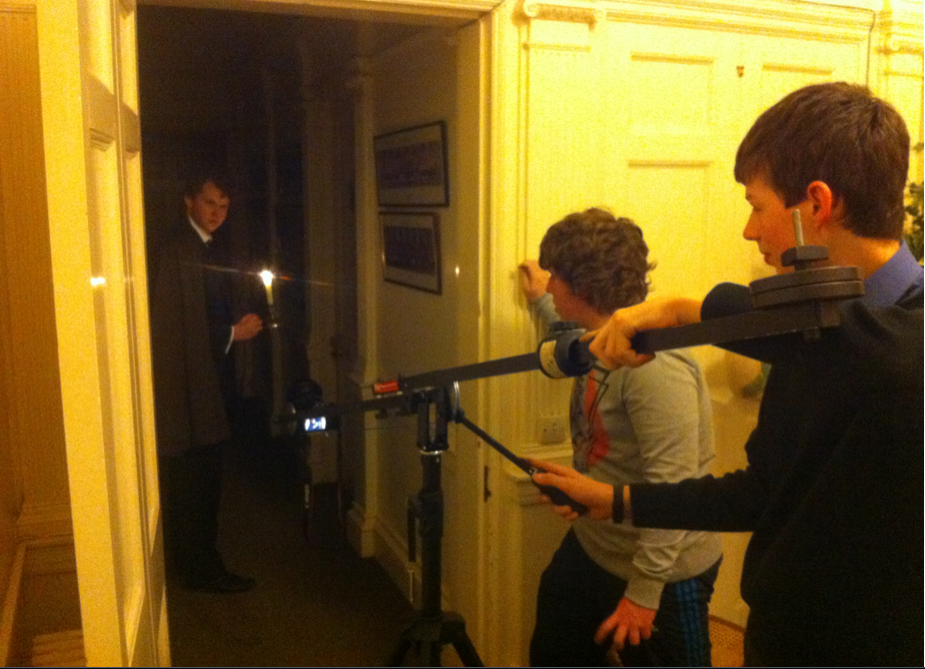
Good to see recent work filming The Raven. This group organized an after-school shoot in the Mansion with camera, lights, boom mike and candle light. Taking photos as you go is a good way of documenting your production journey. They also made a short video on the spot, talking to camera, about what they had set out to achieve during the shoot, then edited it using picture in picture so that an inset video explains the filming.

 |
| This shot shows the use of the home-made wall sconce and the candle light. |
Friday, 25 January 2013
CONSTRUCTION: HOW TO SET OUT A SHOT LIST
Today we studied a professional shot list and will use it as a model for our own productions. Each group should make their own and start to complete it so that you know who is in each shot, how the camera moves and what sound / voice-over accompanies each shot.
 |
| Shot list by Howard Myers |
Saturday, 19 January 2013
RESEARCH: PRESENTATIONAL TOOL FOR AUDIENCE RESEARCH
Use the presentational tool New Hive to create evidence of your audience research into one film that has similar genre codes to the one that you are planning. Include images, text, video, internet links, audio. Cover film classification, audience statistics, primary interviews. if there's space, links to other film websites of a similar genre. Sign up for New Hive HERE

Here is an example of audience research that I have created using New Hive, researching The Raven directed by James McTeigue (2012). You can see it HERE ON NEW HIVE


Here is an example of audience research that I have created using New Hive, researching The Raven directed by James McTeigue (2012). You can see it HERE ON NEW HIVE

Friday, 18 January 2013
RESEARCH: PINTEREST MOOD BOARD

RESEARCH: NOTES FROM THE EXAMINER'S REPORT
This is your lesson today, which you must follow whatever the weather, as you can do this from home!
Research and planning are worth 20% of the marks and should involve the collection of a considerable amount of evidence. Use what the examiner tells us in his report today to make your work good quality. In particular today, focus on the blue guidance below, so that if you are making a traditional thriller set in Victorian times, a satirical mockumentary or a comedy set in a restaurant, your research relates to your outcome.
For example, as The Raven plans period clothes, they will select an image of (say) a character from Sherlock Holmes and place it next to a photo of their own costume choice. Restaurant / chef costumes, recce photos, internet photos inspire the restaurant comedy set.
Final Tap
In addition, they will show evidence of watching similar film openings /film scenes, identify genre codes and conventions, then state exactly what they plan to do that they've learned from their research.
Research and planning are worth 20% of the marks and should involve the collection of a considerable amount of evidence. Use what the examiner tells us in his report today to make your work good quality. In particular today, focus on the blue guidance below, so that if you are making a traditional thriller set in Victorian times, a satirical mockumentary or a comedy set in a restaurant, your research relates to your outcome.
For example, as The Raven plans period clothes, they will select an image of (say) a character from Sherlock Holmes and place it next to a photo of their own costume choice. Restaurant / chef costumes, recce photos, internet photos inspire the restaurant comedy set.
Final Tap
In addition, they will show evidence of watching similar film openings /film scenes, identify genre codes and conventions, then state exactly what they plan to do that they've learned from their research.
- A blog post every other day for three months is a reasonable expectation for candidates (45 minimum)
- Varied posts including images, video and links; different ways of expression & communication
- Well signposted with clear headings (e.g. RESEARCH: SOUNDTRACK) & search engine
- Your individual contribution must be clear!
- Evidence of feedback
- Analytical rather than descriptive approach in genre research
- Link genre research to what YOU produce, so your research into similar products shapes your outcome
- Research is ongoing, so not all complete by the time your construction starts
- For audience research, use a triangulated approach: pick a film, analyse its classification, audience statistics and primary interviews (questionnaires not valued)
- evidence of location recces, planning of actors and costumes
- Explain all your decisions as you go!
Subscribe to:
Posts (Atom)