Tuesday, 8 November 2016

Monday, 7 November 2016
UK CINEMA - EXHIBITION AND EXCHANGE
CLASS AND PREP: Using the sheets that you are given, write the following essay on UK cinema, exhibition and exchange. One (or more) paragraph per point. As you go, give examples of your own viewing habits / that of your peers and family.
YOU HAVE BEEN ASKED TO FINISH THIS ON TUESDAY EVENING before Wednesday's class so that we can proceed to the next step.This essay work prepares you for your summer exam G322. As you can see from the class blog under 'pages', you do not have a choice of question about audiences and institutions in the film industry. Even harder is that the question will have an 'angle'. Here is the 2016 question, with the words 'to what extent' (the angle). This invites you to make a reasoned argument, not to just agree wholesale with the question:
'To what extent has the internet played a significant role in the marketing and exchange of media products in the area you have studied?' (2016)
Taking into account 'to what extent', can you think of non-internet ways of marketing films? Of viewing them? So how important is the internet in the process?
EMAIL ME THE COMPLETED WORK ON TUESDAY EVENING
- Identify the types of cinema available to UK audiences
- Name the 3 biggest cinema chains and then 3 smaller chains
- Explain what kinds of films are shown in multiplexes, who they cater for and their advantages for audiences
- Name the top UK box office grossing films of 2015.
- Identify the independent cinema brands, and explain their character and appeal for audiences. State who they cater for.
- Explain what IMAX offers and why it is still commercially successful.
- Online film consumption / streaming is increasing via multiple platforms. Identify them. Explain the Netflix model. What future trend is likely to develop as a result?
- Draw up your key points in summary.
YOU HAVE BEEN ASKED TO FINISH THIS ON TUESDAY EVENING before Wednesday's class so that we can proceed to the next step.This essay work prepares you for your summer exam G322. As you can see from the class blog under 'pages', you do not have a choice of question about audiences and institutions in the film industry. Even harder is that the question will have an 'angle'. Here is the 2016 question, with the words 'to what extent' (the angle). This invites you to make a reasoned argument, not to just agree wholesale with the question:
'To what extent has the internet played a significant role in the marketing and exchange of media products in the area you have studied?' (2016)
Taking into account 'to what extent', can you think of non-internet ways of marketing films? Of viewing them? So how important is the internet in the process?
EMAIL ME THE COMPLETED WORK ON TUESDAY EVENING
Sunday, 6 November 2016
CATCH UP AND CORRECTIONS
Many of you will have received emails about your blog work as well as found comments on your blog itself. If you have not caught up with your work, as your Sixth Form Review pointed out, you are now required to attend Study Hall, as forewarned. Remember that you should have posts on
- analysing the representation in the Marc Riboud photograph,
- a Piktochart on Audience (which includes the Uses and Gratifications model of audience behaviour) with visual illustration (hence, Piktochart)
- a post on The Business of Film (i.e. the fact that you are following the course, what you are gaining from it and what in particular you can apply to your own film production work, such as thinking about your audience).
- at least 4 detailed, lucid, well-illustrated analyses of film openings, presented in at least two formats, such as SlideShare or Emaze. You must check that a third party can open your work! Use a friend to check.
- you and your group should find time to edit and post your Preliminary Exercise
Monday, 31 October 2016
BFI STUDY DAY

Year 12: ‘Introduction to the Film Industry: an AL Study Day’ at the
British Film Institute on Wednesday 2 November 2016
The media department has arranged a
trip to The BFI South Bank to attend a study day in support of their OCR GSE
examination Key Concepts: Audiences and Institutions. It will be
delivered by Rob Miller, OCR media studies lecturer and consultant. The trip
will be led by Mrs Mann.
A
study of the film industry is a requirement of all Film and Media Studies
specifications and this interactive day offers an opportunity to find answers
to key examination questions. There will be interactive, clip-based
presentations about film production, distribution, exhibition and exchange in
an online age with a particular focus on the ways in which digitisation has
changed film consumption and distribution. Guest speakers from both mainstream
and independent sectors will deliver Q&A sessions. A resource pack for students
on the day is also included.
UPDATE: We are now using the resource pack to write an exam essay for G322 on audiences and institutions in the film industry.
 Gareth Lowrie of NBC Universal discusses film marketing with Rob Miller
UPDATE: We are now using the resource pack to write an exam essay for G322 on audiences and institutions in the film industry.

 |
| We discuss the significance of IMAX as a platform |
Tuesday, 11 October 2016
THE BUSINESS OF FILM
Sign up for a FutureLearn MOOC starting 17 October 2016 called THE BUSINESS OF FILM. This will be a huge support in both your summer exam question on the film industry and also provide you with evidence of research for your film production module (questions 3 and 5 on distribution and attracting & addressing audiences).

Your current PREP is to complete the Infographic on AUDIENCES started yesterday. We look at Stuart Hall and reception theory today as well as BFI exit polls.
Our starter activity yesterday was the Guardian's award-winning video advertisement HERE We discussed the importance of intertextuality. The meaning of this video ad depends on the audience's knowledge of the original story.
 Our starter activity today was watching and discussing the screening of The Mass of Men by student film makers from the National Film and Television School.
This short film is set primarily in one location (a benefits office) and opens / closes outside at a bus stop. Its editing is striking as tension builds, marshalling the audience's sympathy for the wronged, desperate man who is trying to be a good person but thwarted at every turn. The opening soundtrack (Dido's Lament by Purcell) makes poignant ironic reference to the closing words of Henry David Thoreau: the mass of men lead lives of quiet desperation.

Today we also viewed and discussed award-winning AL film openings screened at the Media Magazine Production Competition Awards at the BFI in 2015 and 2016, where we at Claremont have had a number of short-listed entries.
 Arising out of these film openings is the way that dystopias can feature in films. We look at the concept of Jerememy Bentham's Panopticon.
It has been used as a metaphor for internalized self-policing in, for example, the writings of Michel Foucault in Discipline and Punish (1977).
'Foucault shows the development of the Western system of prisons, police organizations, administrative and legal hierarchies for social control - and the growth of disciplinary society as a whole. He also reveals that between school, factories, barracks and hospitals all share a common organization, in which it is possible to control the use of an individual's time and space hour by hour.' (Wikipedia)
 We also looked at collecting wild sound for movie making and uploading it to SoundCloud.

Another good idea is to start thinking about visuals for making your production company ident: we looked at two or three exhibits from exhibitions (fishes) to remind you that you can 'collect' ideas that will form the basis of visuals.
Your current PREP is to complete the Infographic on AUDIENCES started yesterday. We look at Stuart Hall and reception theory today as well as BFI exit polls.
Our starter activity yesterday was the Guardian's award-winning video advertisement HERE We discussed the importance of intertextuality. The meaning of this video ad depends on the audience's knowledge of the original story.
This short film is set primarily in one location (a benefits office) and opens / closes outside at a bus stop. Its editing is striking as tension builds, marshalling the audience's sympathy for the wronged, desperate man who is trying to be a good person but thwarted at every turn. The opening soundtrack (Dido's Lament by Purcell) makes poignant ironic reference to the closing words of Henry David Thoreau: the mass of men lead lives of quiet desperation.
Today we also viewed and discussed award-winning AL film openings screened at the Media Magazine Production Competition Awards at the BFI in 2015 and 2016, where we at Claremont have had a number of short-listed entries.
 Arising out of these film openings is the way that dystopias can feature in films. We look at the concept of Jerememy Bentham's Panopticon.
It has been used as a metaphor for internalized self-policing in, for example, the writings of Michel Foucault in Discipline and Punish (1977).
'Foucault shows the development of the Western system of prisons, police organizations, administrative and legal hierarchies for social control - and the growth of disciplinary society as a whole. He also reveals that between school, factories, barracks and hospitals all share a common organization, in which it is possible to control the use of an individual's time and space hour by hour.' (Wikipedia)

Another good idea is to start thinking about visuals for making your production company ident: we looked at two or three exhibits from exhibitions (fishes) to remind you that you can 'collect' ideas that will form the basis of visuals.
Monday, 10 October 2016
RESEARCH: AUDIENCES
You research AUDIENCES and show what you have learned in an infographic using PIKTOCHART.
When the writing is done, you will present it all crisply using Piktochart. The aim is to demonstrate to the moderator that you know about theoretical frameworks and about how producers target audiences.
At the same time, the exercise will help you prepare for the A2 exam Section A question 1b (audience).
All media texts are produced with an audience in mind - that is to say a group of people who will receive the text and make some sort of sense out of it.
So audience is part of the media equation – a product is produced and an audience receives it. Television producers need an audience for their programmes, so they can finance those programmes and make more programmes that the audience likes. Advertisers need an audience who will see or hear their advertisements and then buy the products.
A media text is planned with a particular audience in mind. A television producer has to explain to the broadcasting institution (e.g. BBC or ITV) who is the likely audience for this particular programme.
Are they under 25 years old or older, mainly male or mainly female, what are they interested in? The television audience varies throughout the day and night, and television and radio broadcast for 24 hours, seven days a week. How do we know who is watching or listening at any one time? This is where audience research becomes important. A media producer has to know who is the potential audience, and as much about them as possible.

Read The Guardian article. What films have been implicated in producing copycat crime?

The uses and gratifications model of audience behaviour (Blumler and Katz, 1974)

The audience then mediate the information received directly from the media with the ideas and thoughts expressed by the opinion leaders, thus being influenced not by a direct process, but by a two step flow.
This theory appeared to reduce the power of the media, and some researchers concluded that social factors were also important in the way in which audiences interpret texts. This led to the idea of active audiences.
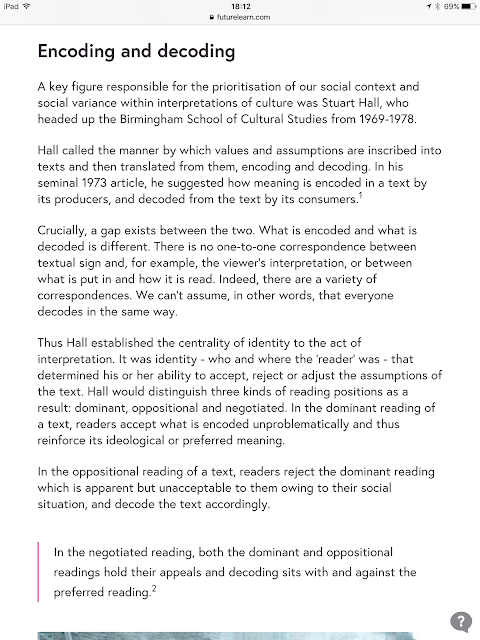
Stuart Hall’s encoding decoding model; dominant, negotiated and oppositional readings; why Hall says he studies culture instead of media specifically, and media hegemony. Audiences are no longer considered passive recipients.
AUDIENCES
Start by making a blog post with text and images for each point (will become a slide / section) in the right order. Keep each section to the point. You are not writing a novel. You are proving that you have done the research.When the writing is done, you will present it all crisply using Piktochart. The aim is to demonstrate to the moderator that you know about theoretical frameworks and about how producers target audiences.
At the same time, the exercise will help you prepare for the A2 exam Section A question 1b (audience).
CONTENT. You should cover:
1 - AUDIENCE: A KEY CONCEPTAll media texts are produced with an audience in mind - that is to say a group of people who will receive the text and make some sort of sense out of it.
So audience is part of the media equation – a product is produced and an audience receives it. Television producers need an audience for their programmes, so they can finance those programmes and make more programmes that the audience likes. Advertisers need an audience who will see or hear their advertisements and then buy the products.
A media text is planned with a particular audience in mind. A television producer has to explain to the broadcasting institution (e.g. BBC or ITV) who is the likely audience for this particular programme.
Are they under 25 years old or older, mainly male or mainly female, what are they interested in? The television audience varies throughout the day and night, and television and radio broadcast for 24 hours, seven days a week. How do we know who is watching or listening at any one time? This is where audience research becomes important. A media producer has to know who is the potential audience, and as much about them as possible.
2 - AUDIENCE PROFILING
TYPES OF AUDIENCE RESEARCH
Audience profiling such as socioeconomics,demographics, psychographics |
| A common and traditional method of audience research is known as demographics. This defines the adult population largely by the work that they do. It breaks the population down into 6 groups, and labels them by using a letter code to describe the income and status of the members of each group. |
 |
| PSYCHOGRAPHICS (above) is a way of describing an audience by looking at the behaviour and
personality traits of its members. Psychographics labels a particular
type of person and makes an assessment about their viewing and spending
habits. The advertising agency Young and Rubican invented a successful psychographic profile known as their 4C’s Marketing Model http://www.4cs.yr.com The 4 Cs stand for Cross Cultural Consumer Characterisation. They put the audience into groups with labels that suggest their position in society |
3 - AUDIENCES AS PASSIVE (4 items)
THE MEDIA EFFECTS MODEL
The media effects (hypodermic syringe) modelSTUDIES USED TO SUPPORT THE EFFECTS MODEL
Bobo doll (Albert Bandura, 1961);MORAL PANICS
What are moral panics?THE ROLE OF THE MEDIA IN MORAL PANICS

Read The Guardian article. What films have been implicated in producing copycat crime?
4 - ADORNO AND THE CULTURE INDUSTRY
For Theodore Adorno, advertising creates false needs. Adorno (1903-69) argued that capitalism fed people with the products of a 'culture industry' - the opposite of 'true' art - to keep them passively satisfied and politically apathetic.
Adorno suggested that
culture industries churn out a debased mass of unsophisticated,
sentimental products which have replaced the more 'difficult' and critical art
forms which might lead people to actually question social life.
False needs are cultivated in people
by the culture industries. These are needs which can be both created and
satisfied by the capitalist system, and which replace people's 'true' needs -
freedom, full expression of human potential and creativity, genuine creative
happiness.
Products of the culture industry may be
emotional or apparently moving, but Adorno sees this as cathartic - we might
seek some comfort in a sad film or song, have a bit of a cry, and then feel
restored again.
5 - AUDIENCES AS ACTIVE (3 items)

MASLOW'S HIERARCHY OF NEEDS
We learn about higher order needs using Maslow's Hierarchy of Needs. Where does popular culture sit in this debate?WHY AUDIENCES CONSUME TEXTS: THE USES AND GRATIFICATIONS MODEL
We look at different models of audience behaviour. Mediaknowall will remind you of what we discussed.The uses and gratifications model of audience behaviour (Blumler and Katz, 1974)
THE TWO-STEP FLOW MODEL
Katz and Lazarsfeld assumes a slightly more active audience. It suggests messages from the media move in two distinct ways.
First,
individuals who are opinion leaders, receive messages from the media
and pass on their own interpretations in addition to the actual media
content.
The information does not flow directly from the text into the minds
of its audience, but is filtered through the opinion leaders who then
pass it on to a more passive audience. The audience then mediate the information received directly from the media with the ideas and thoughts expressed by the opinion leaders, thus being influenced not by a direct process, but by a two step flow.
This theory appeared to reduce the power of the media, and some researchers concluded that social factors were also important in the way in which audiences interpret texts. This led to the idea of active audiences.
6 -RECEPTION THEORY
STUART HALL AND CULTURAL STUDIES
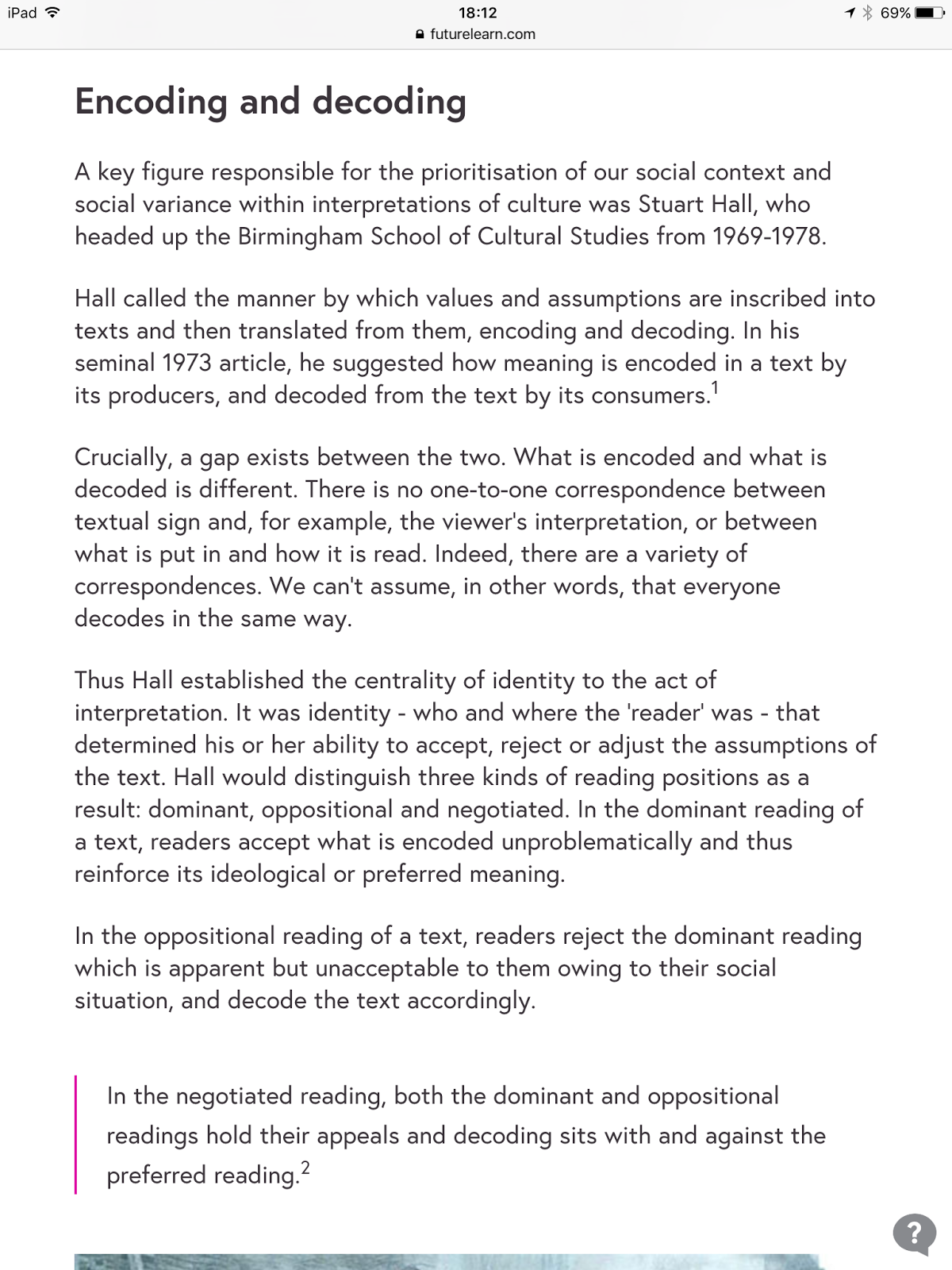
RECEPTION THEORY focuses on the scope in textual analysis for 'negotiation' and 'opposition' on the part of the audience. This means that a text ( a book, film, advert, poster or other creative work) is not passively accepted by the audience but that the reader / viewer interprets the meanings of the texts based on their individual cultural background and life experiences.Stuart Hall’s encoding decoding model; dominant, negotiated and oppositional readings; why Hall says he studies culture instead of media specifically, and media hegemony. Audiences are no longer considered passive recipients.
7 - EXIT POLLS
The BFI carries out exit polls to assess audience response at film screenings. Here is one example (name, director, date).8 - THE ROLE OF THE BBFC
 |
| We look at issues such as discrimination, drugs, horror, dangerous and easily imitable behaviour, language, nudity, sex, and violence when making decisions. The theme of the work is also an important consideration. We also consider context, the tone and likely impact of a work on the potential audience. |
NARRATIVE VIEWPOINTS: GUARDIAN NEWSPAPER ADVERTISING
We watch two award-winning pieces of advertising:
The Guardian's 1986 'Points of view' advert

Subscribe to:
Posts (Atom)