Wednesday, 23 November 2016

TREATMENT

Write a treatment for your film opening.
Title of blog post: PLANNING: TREATMENT
Once I green light the treatment, you start the storyboard, shot list and call sheets.
PLANNING: HOW TO WRITE A TREATMENT


A treatment is a description in clear English in the present tense setting out what your product / film / video has in it, starting at the beginning in the case of a video which has a linear narrative.


Other sites include  http://www.wikihow.com/Write-a-Script-Treatment and http://www.lightsfilmschool.com/articles/treatments/
Here is a sample treatment:
SAMPLE FILM TREATMENT courtesy of Movie Outline HER
Notice that the first time that a character is introduced, their name is in CAPITALS.


Tuesday, 22 November 2016

THE TOP LINE AND BIG QUESTION

Watch this presentation by Frank Ash then write your own Topline and Big Question for your film opening. You write up a blog post explaining all this. You include a visual from the Frank Ash presentation, explaining who he is and what you learned from the presentation. Your blog post title is PLANNING:  THE TOP LINE AND BIG QUESTION


For Frank Ash, Creative Consultant who has taught storytelling and creativity techniques to teams across the BBC and beyond, it is important to focus on the audience: what will interest the audience? How will the narrative develop?


"So, if you’re aiming for your film to reach a large audience online, making sure it has universal appeal will be key"


TOP LINE DEFINITION: Think about your favourite book or film or any ‘good story’ you recently watched online, could you sum up its narrative into ‘one elegant sentence’ to provide its ‘toppling’


BIG QUESTION DEFINITION: What was its big story question, and how important was it to your appreciation of the text?"

TREATMENT See below for how to write a treatment. 
  • After writing the treatment, you create a STORYBOARD  (hand drawn on the sheets that I give you)
  • and a SHOTLIST (a collaborative document that you can do together in GoogleDocs). 

Monday, 21 November 2016

DISTRIBUTION: ABOVE THE LINE / BELOW THE LINE MARKETING

Do you know the difference between 'above the line' and 'below the line' marketing?
Read the infographic below to find out.


Saturday, 19 November 2016

FORMULAIC FILMS

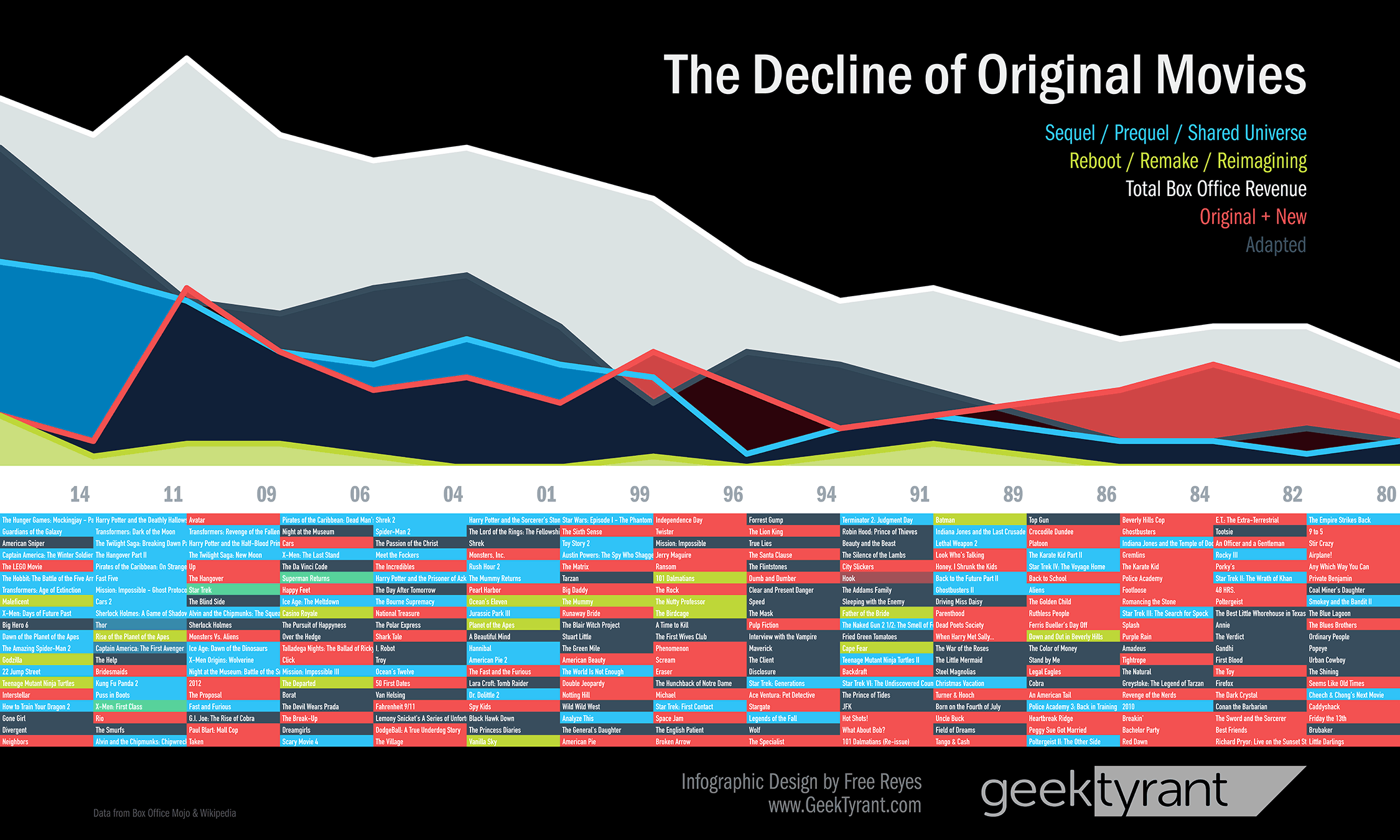
It can be valuable for film projects to already have audience recognition from books or plays or the lives of well-known people. This is often referred to as a film project being ‘pre-branded’. One of the strongest ways a film can be pre-branded is if it is a sequel to a previously released film. Having a film based on a recognisable existing property is thought to reduce the risk in an uncertain business.


Some commentators feel that cinema is suffering from too many pre-branded feature films. They feel that there is a loss of creativity in many of the big budget films that are made nowadays. A number of observers have noted that more and more big budget high box office films are sequels, prequels or remakes. They argue that, though this may be OK in the short term, it means that movies may end up being less appealing to audiences in the long term. You may wish to follow these arguments further: some suitable links are provided below (including the original source for the infographic shown below).
SOURCE OF INFOGRAPHIC Read the article

COLLECTIVE CREATIVITY Read the article

WHAT COUNTS AS A BRITISH FILM?


Should we protect home-grown production?

The fiscal incentives offered in the UK to film production are generous. In order to qualify for such tax relief a film is scored in a test designed to see whether it qualifies as being a British film.
You might think that it is obvious what is meant by a ‘British film’, but it’s not as simple as that. The term encompasses a much wider range of films than you might imagine.
A film such as Gravity qualifies as British, despite its global, US studio credentials, because UK post-production played a significant part in its production. In addition to UK specific criteria the test is heavily influenced by European Union (EU) regulation and therefore, in certain aspects, is not just about the UK.
There is a broader cultural measure: subject matter and lead characters can be British or any country from the EU. Similarly a film can qualify on the basis of its language. Any EU indigenous language including English qualifies.
Alex Hamilton is Managing Director of a film distribution company  He argues that there is a natural limit on the growth of British film-making that is purely home grown. There are only so many resources and so much money available:
ALEX HAMILTON: Inward investment: we always just should assume it's something of a double-edged sword. It's great that you can encourage inward investment into the UK from the studios, and that there a means in which to do that, but you have to accept it the indigenous industry, as it were, is only a thing of a certain size. If it takes a lot of inward investment from the studios, it inevitably constricts the space within which the indigenous industry can promote and produce homegrown films. It's a perennial debate. The notion is that Gravity is a British film and it qualified as a British film. Now it's a very high end top quality studio product, which benefited from the welcoming context for inward investment.
 It actually should be that our indigenous, homegrown, film industry is supported and made wider. Is film greater than the sum of its economic parts? I think you'd get a lot of people would say, that yes any industry, and film is no different from any other, is greater than the sum of its economic parts because film has a cultural impact, a social impact. It's not simply about the primacy of the economic narrative. I think that's the double-edged sword of inward investment. It's great that we're making Star Wars and Marvel and other big, big movies in the UK.
 It keeps a lot of people in work, generates real jobs, but we also want to be creating the Billy Elliots, The Full Monty, the Trainspottings. I'm trying to think of more recent examples, actually and just suddenly struggling, but very successful British films.

Friday, 18 November 2016

UK FILM: THE VALUE CHAIN

A functioning example of a film value chain, detailed in text
A representation of the film value chain

The film business value chain


Above is a representation of the film value chain. This is a summary of a very complicated process. This chart could be drawn with different contents, but it highlights the different stages in the creation and consumption of an independent feature film.
Development is a crucially important process in its own right. You will learn more about this next week, but a lot of effort goes into getting a film idea, and film script, right before the project ‘goes to market’ to be financed.
Finance: In the world of independent film, in general, each film is financed on its own terms and in its own way. Major studios are able to apply their own funds or secure long-term investment for film funding, so the finance process is not such a concern for them, but in the world of independent film, finance is the most difficult stage.
Pre-pre-production (pre-prep): Note the last development stage, with a dotted line relationship to finance. It is called pre-pre-production and refers to a very difficult stage in the life of some films that are working under tight timeframes.
The film is not yet officially financed. However, money needs to be spent in order to secure key cast and crew, and start to find locations, and so forth. Someone needs to fund pre-prep, but this is a highly risky investment, because the film might collapse at the last minute.
Production is in some ways the simplest part of the chain. Though it has its own risks and uncertainties, it is a very established ‘industrial’ process. It is divided into pre-production, the official ‘prep’ period, principal photography, when the camera is rolling, and post-production when the editing and sound and visual effects (VFX) and music aspects are incorporated.
Distribution is the process of getting the film into the hands of the theatre chains, broadcasters, video stores and video on demand (VoD) operators. The companies that do this are called distributors. In general a producer uses a sales agent to license a film to distributors outside the producer’s own country.
Exploitation is the process by which consumers actually experience the film. The most important and first exploitation market is the cinema and the companies that run cinemas and cinema chains are called exhibitors. However, as we will discuss, films are more and more being consumed in different ways with the growing importance of digital technologies.
We have structured this course around the different elements of the value chain. In Week 2 we will talk about development. In Week 3 we jump to distribution and exploitation. A major source of finance is from distributors and sales agents paying for the rights to the film before it is made. Therefore, you really need to have a sense of how distribution works before you can understand finance. So Week 4 is finance. Week 5 is production itself. In Week 6 we will take a step back and consolidate.
The term ‘value chain’ has this very specific meaning in the film industry, as all the stages of life that a film project goes through from the very beginning to the very end. However, the same term is used in a slightly different way to help analyse business processes in many industries. To find out more about this, you can read the article by Hilary Collins, ‘Porter’s value chain and the business of film’. This is available on The Open University’s source of free learning, OpenLearn.
From the wider business perspective, to form a successful film, which is a product for an organisation, it is important to add value in each activity that the product goes through during the life cycle. The best possible value can be achieved in the film development process by adding value in each stage. Porter classified the generic value added activities into two:

  1. primary activities which are classified as product and market related activities
  2. support activities that are related to infrastructure, technology, procurement, and human resource management.
Do you think these might relate to activities or processes in the film business and if so, how?
Each film has its own life cycle which is defined by many factors and negotiations. Is it an existing brand or franchise? Are there any big stars in it? What audience would be drawn to this particular film? What is its potential to attract public support? The answers to these questions often determine who has the most influence in the journey a film takes from idea to screen: who has the most power.

Why development is so important and so hard

Because development is such a risky process, it is not something that all players in the film value chain are able to do – particularly those that are commercial players.

As we have seen the source of the film itself is a key factor. For the major studios the ‘star’ system is crucial as well as the development of major franchises that spawn one blockbuster after another. However, in the world of independent feature films, it is – in a sense – much harder to predict outcomes.

"Avatar for example took 10 years to make since when James Cameron wanted to make it it 1997, there wasn't enough technology to ensure the film would be a success and no one would back the film properly due to this. The detail in the film was also part of the reason that the film took so long. Just developing the language that the Na'vi spoke took enormous amounts of time. However the wait was clearly worth it as it is one of the highest grossing movies of all time." Ryan Wiggins


UK FILM MAKING

How healthy is UK film production?

In addition to the BFI Film Fund, which Ben Roberts runs, there are two other very important public service organisations that provide much of the support to British independent film-making. They are BBC Films, the film arm of the BBC and Film4, the film arm of Channel 4 (links below).

BEN ROBERTS: I think there are lots of different ways of looking at the health of the industry. There is a lot of investment in film production in the UK, but a lot of it is coming from outside the UK, so as studios coming in making films like Star Wars or The Avengers here. There is a benefit, quite a significant benefit, of that activity to people who are working outside the studio system, because there's a knock-on effect for investment in skills and other training.

All of the studios, and a lot of the visual effects companies who are basically being funded through their work with the studios, pass on quite a lot of those benefits to independent producers and lower budget filmmaking at a lower cost as well. But what we do have, which is very health and healthier than a lot of other countries, is we do have a very, very supportive funding system through the tax relief, through ourselves, and the money that gets put into film through lottery. And we have two broadcasters who invest heavily in film production as well. It means that our films tend to travel well.

We train up filmmakers, producers, on screen talent, cast, who move quite comfortably between independent and studio filmmaking, and also who move between UK filmmaking and international filmmaking. So if you look at what's being awarded Oscars, or BAFTAs in terms of filmmakers, technicians who are working behind the screen, or actors, whether they're in American films, or British films, a lot of them are British. So we have a very healthy skills, and training system here in the UK.
© The Open University

Do you know about C4?


Do you know about BBC films?